
Why Companies Move to Headless CMS & Next.js: Scalability Benefits
Share this article
In the past, websites were often built using monolithic CMS (Content Management System) like WordPress or Drupal. In this system, the backend (where you manage content) and frontend (the display users see) are tightly coupled in one package.
While convenient to start with, this approach has serious limitations, especially in terms of scalability and flexibility.
Now, large companies and forward-thinking startups are massively shifting to a new architecture: Headless CMS combined with modern frontend frameworks like Next.js. Let's explore why this shift is not just a trend, but a strategic investment for the future.
What is Headless CMS?
Headless CMS is a content management system that only handles the backend. It doesn't care about how or where the content will be displayed.
Imagine a "head" (frontend/display) that has been separated from the "body" (backend/content).
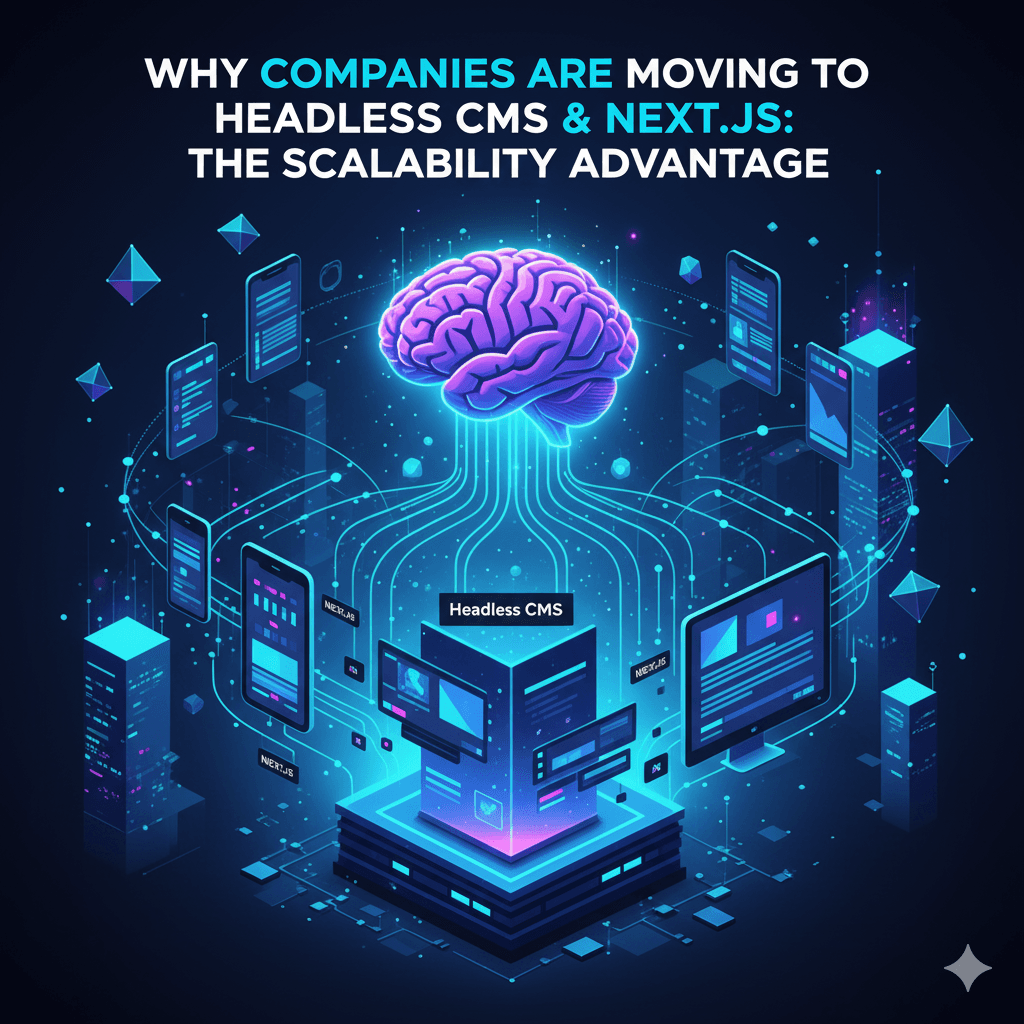
This CMS provides its content through an API (Application Programming Interface). This means developers have complete freedom to build the "head" or multiple "heads" using any technology they want. The same content from one CMS can be displayed on:
- Website (built with Next.js)
- Mobile apps (iOS and Android)
- IoT devices (like smartwatches or digital displays)
- Third-party applications
Enter Next.js: Supercharged Frontend
Next.js is a React framework designed to build high-performance modern web applications. It becomes the perfect partner for Headless CMS for several key reasons:
- Outstanding Performance: Next.js offers various rendering methods, such as Server-Side Rendering (SSR) and Static Site Generation (SSG). This means web pages can load very quickly, which is crucial for SEO and user experience.
- Superior Developer Experience: With features like hot-reloading, file-based routing, and automatic image optimization, Next.js allows developers to build features faster and more efficiently.
- Flexibility: Next.js can fetch data from any source—including APIs from Headless CMS—with ease.
Scalability Benefits: Why This Matters for Your Business?
Scalability is a system's ability to handle growth—whether it's traffic spikes, feature additions, or expansion to new platforms—without experiencing performance degradation. This is why the combination of Headless CMS and Next.js is so superior.
1. Traffic Scalability
- Monolithic: When your WordPress website goes viral, your server can be overwhelmed because every visit requires backend processing and rendering.
- Headless + Next.js: Most pages can be generated as static files and served through a global CDN (Content Delivery Network). This means your website can handle millions of visitors with minimal latency and much lower server costs.
2. Feature Scalability
- Monolithic: Adding complex new features is often limited by existing plugins and themes. Customization can become a nightmare.
- Headless + Next.js: Because frontend and backend are separate, teams can work independently. The frontend team can build new interface features without disturbing the content team, and vice versa. This dramatically accelerates the development cycle.
3. Platform Scalability (Omnichannel)
- Monolithic: Your content is locked inside the website. Bringing it to a mobile app means building an entirely new system.
- Headless + Next.js: The principle of "create content once, distribute everywhere" becomes reality. Content you write in Headless CMS can be directly pulled and displayed on websites, apps, or new digital platforms in the future, ensuring brand consistency everywhere.
Investment for the Future, Not an Ad-hoc Solution
Choosing Headless CMS architecture with Next.js is not a temporary solution; it's a foundation for growth. It positions your business to:
- Adapt Quickly: When new frontend technologies emerge, you can build a new "head" without having to migrate all your content.
- Deliver the Best User Experience: With the speed and flexibility offered, you can create modern and satisfying digital experiences.
- Reduce Technical Debt: By separating components, you create a system that's easier to maintain, debug, and upgrade over time.
For companies serious about growth and wanting to build a lasting digital presence, switching to this architecture is no longer a choice, but a strategic necessity.
Ready to Escape OTA Dependency?
Let's build your Direct Booking system. Calculate how much you can save today.
Get Free Consultation