
What is an API? Complete Explanation for Beginners
Share this article
Have you ever ordered a ride-hailing service, checked the weather forecast on your phone, or logged into a website using your Google account? If yes, you've actually been using an API.
But what exactly is an API?
What is an API?
API stands for Application Programming Interface.
Let's break down this term:
- Application: An app or program (e.g., Gojek app, Google Maps, your website).
- Programming: The process performed by developers.
- Interface: The point where two systems meet and interact.
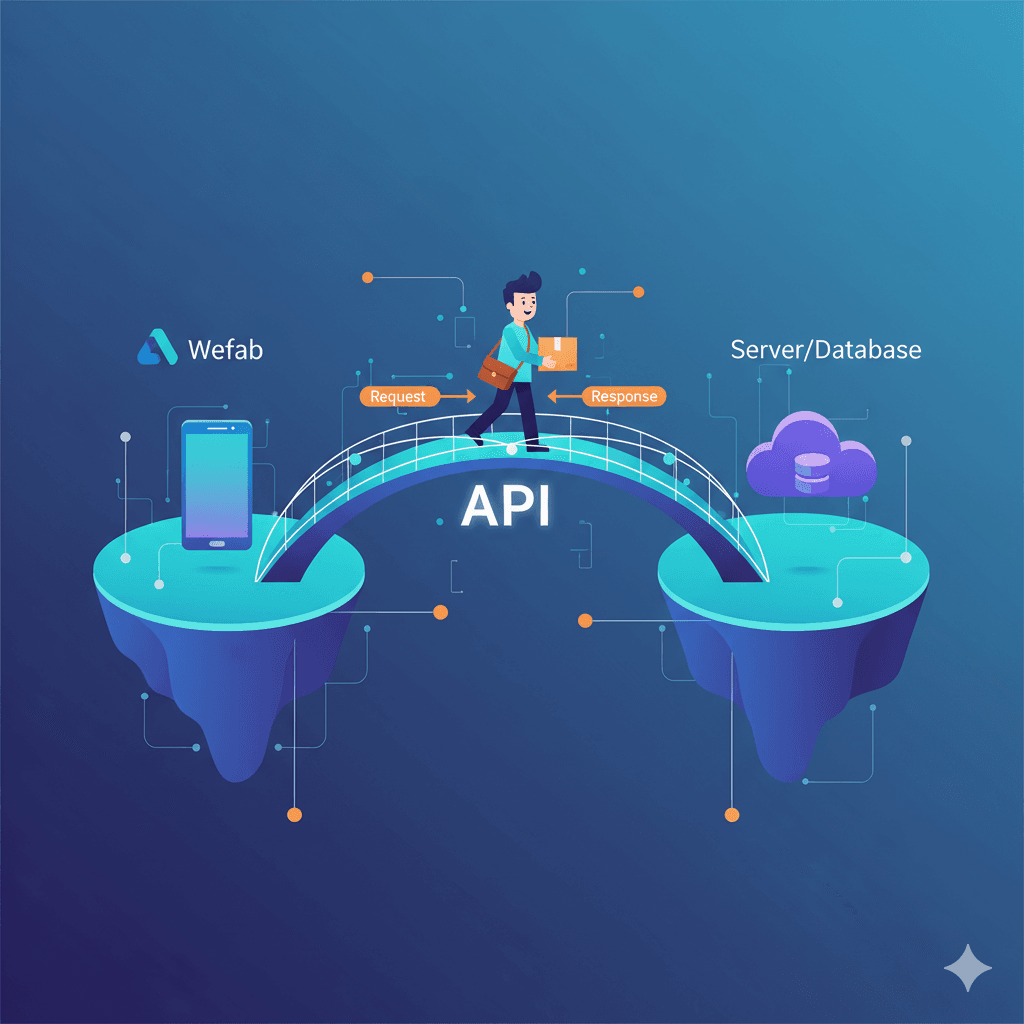
Simply put, an API is an intermediary that allows two different applications to "talk" to each other and exchange data.
The Best Restaurant Analogy
The easiest way to understand an API is through a restaurant analogy.
Imagine you are a customer (your application) at a restaurant. The kitchen is the server (another system) where all the data and functionality reside. You can't just walk into the kitchen and grab your food yourself.
This is where the waiter (API) comes in.
- You look at the menu (API documentation) to see what you can order.
- You tell the waiter (API) your order (this is called a request).
- The waiter (API) takes your order, goes to the kitchen (server), and tells the chef what to prepare.
- Once your order is ready, the waiter (API) picks up the food from the kitchen and delivers it back to your table (this is called a response).
In this scenario, the waiter (API) is the intermediary handling communication. You (the application) don't need to know how the kitchen (server) cooks the food; you just need to know how to order from the menu.
How Does an API Work?
Technically, the process runs very quickly and usually follows these steps:
-
Request: Your application (client) sends a request to the server through the API. This request contains specific information, such as:
- Endpoint: The specific URL destination of the request (e.g.,
https://api.weather.com/v1/jakarta). - Method: The type of action requested (Most common examples:
GETto retrieve data,POSTto send new data). - Header & Body: Additional information, such as authentication data (API Key) or data to be sent.
- Endpoint: The specific URL destination of the request (e.g.,
-
Validation & Execution: The server receives the request through the API. It will validate the request (e.g., "Is this API key valid?"). If valid, the server will process the request—retrieving data from the database, performing calculations, or executing other functions.
-
Response: After completion, the server sends data back to your application through the API. This data is usually formatted in JSON (JavaScript Object Notation) or XML, which are lightweight data formats that are easy for machines to read.
Why Are APIs So Important?
APIs are the backbone of the modern web. Without them, the internet wouldn't be as integrated as it is today.
1. Efficiency and Time Savings
Instead of building everything from scratch, developers can use existing APIs.
- Example: Why build your own mapping and satellite system when you can use the Google Maps API? Why build your own payment system when you can use APIs from Midtrans or Stripe?
2. Integration
APIs allow different services to connect. This is what makes mashup applications (combinations of multiple services) possible.
- Example: Travel sites like Traveloka use APIs from various airlines, hotels, and payment systems to present everything on one platform.
3. Abstraction and Security
APIs hide the complexity of the system behind them.
- Security: APIs act as gatekeepers. They only expose necessary data and hide the rest of the infrastructure (like databases). You don't give everyone access to your database, but you can provide controlled API access.
- Simplicity: Developers using the API don't need to know what programming language is used on the server or how complex the database is. They just need to know how to send a request and receive a response.
4. Innovation
By providing an API, a company enables other developers to build new businesses or features on top of their platform. This drives innovation that the API creators themselves might not have thought of.
Conclusion
An API (Application Programming Interface) is a contractual bridge between two applications. It is not the database or server itself, but rather a courier that takes requests, delivers them to the system, and brings the response back to you.
Every time you use an app on your phone, you're almost certainly using an API.
Ready to Escape OTA Dependency?
Let's build your Direct Booking system. Calculate how much you can save today.
Get Free Consultation